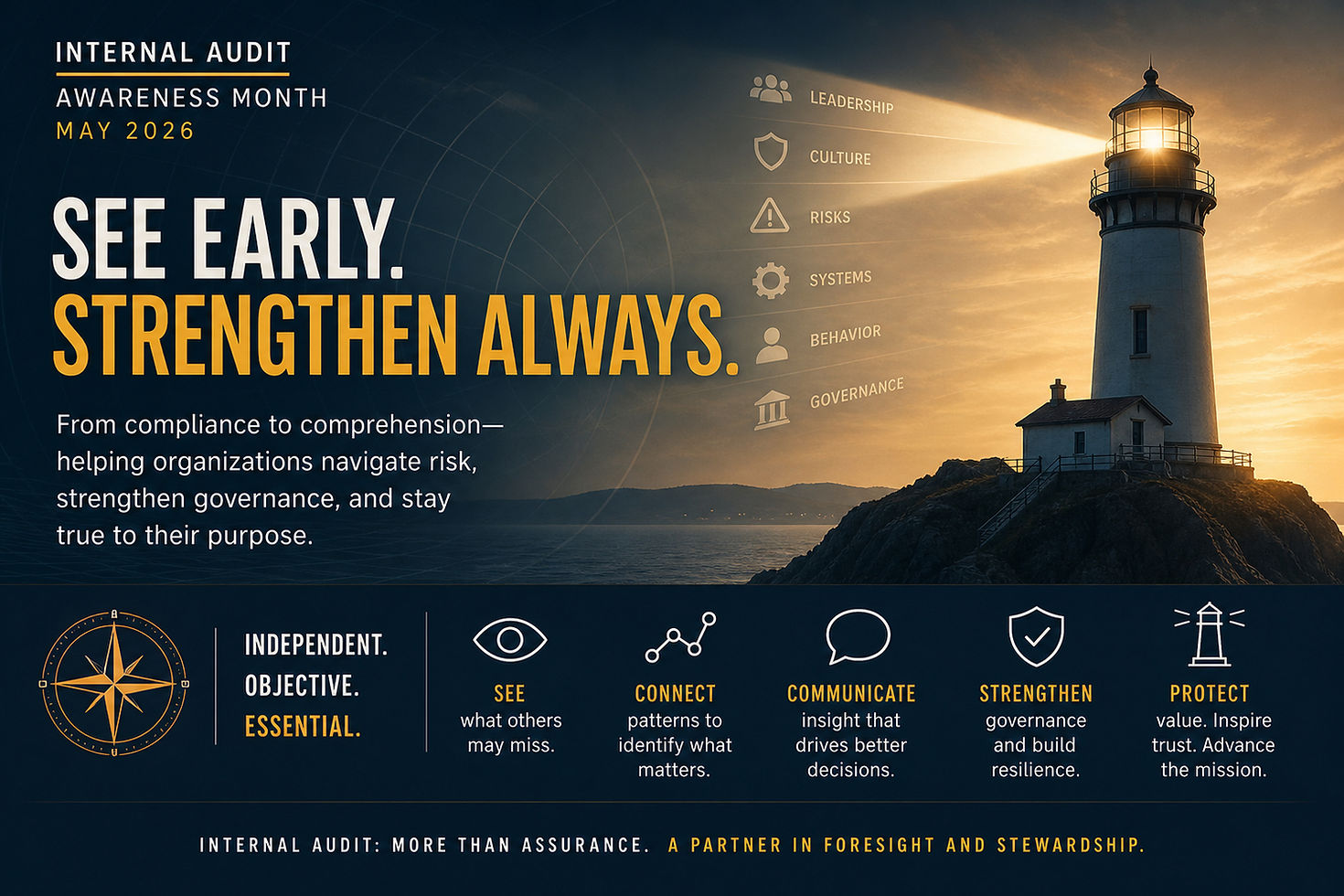
Internal Audit Awareness Month 2026
- Roger Ngong
- May 4
- 3 min read
Updated: May 8
From Compliance to Comprehension: What Internal Audit Must Help Organizations See
Every May, organizations recognize Internal Audit Awareness Month.
Most messages follow a familiar pattern: Internal audit strengthens controls. Internal audit provides assurance. Internal audit protects value.
All true. Nonsufficient.
If the past decade has made anything clear, it is this: organizations do not fail because they lack controls. They fail because they do not see what is forming beneath them.
And by the time a control breaks, the failure is already well underway.
The Limits of Assurance
Internal audit has traditionally been positioned as a function of verification:
Were controls designed appropriately?
Were they operating effectively?
Were exceptions identified and addressed?
These questions matter. But they operate at the surface.
As explored in, control failures are typically the final stage of a much longer process—one that begins in leadership behavior and organizational culture long before it becomes visible in a test of controls.
When audit focuses only on compliance, organizations receive assurance about the past.
What they need—urgently—is foresight about the future.
Why Good Organizations Drift
Across sectors—corporate, nonprofit, public—the same patterns repeat.
Not because organizations are flawed, but because they are human.
Over time, institutions drift under the influence of predictable dynamics:
Confidence hardens into resistance to challenge
Growth outpaces the systems meant to sustain it
Fear suppresses bad news
Known risks remain unresolved
Silos fragment the enterprise
New initiatives substitute for fixing underlying issues
Capacity is consumed faster than it is replenished
None of these emerge as crises at first. They appear as small, reasonable decisions—taken in isolation, justified in context.
But they accumulate.
And internal audit is uniquely positioned to see that accumulation.
The Auditor’s Advantage
No other function is structurally positioned to:
See across silos
Bypass hierarchy
Observe patterns across time
Compare what is said with what is done
This vantage point is rare.
But it is often underused.
When audit limits itself to documenting control gaps, it underutilizes its own perspective.
The real value lies in connecting signals:
Repeat findings that suggest systemic inaction
Turnover patterns that reveal cultural pressure
Delayed remediation that signals misaligned priorities
Fragmented systems that obscure enterprise risk
Individually, these are findings.
Collectively, they are diagnosis.
From Compliance to Comprehension
Internal audit is evolving—not away from rigor, but beyond it.
The shift is subtle but significant:
Traditional Audit | Emerging Audit |
Tests controls | Interprets systems |
Verifies compliance | Diagnoses patterns |
Reports findings | Explains trajectories |
Focuses on “what failed” | Explains “why it keeps failing” |
This is not a rejection of assurance.
It is an expansion of it.
Because organizations do not need more reports. They need help answering harder questions:
What behaviors are our systems rewarding?
What risks are being normalized rather than managed?
Where are we relying on heroics instead of design?
What truths are unsafe to raise?
What are we choosing not to see—and why?
Making Drift Visible
One of the challenges in governance is not the absence of data—but the absence of interpretation.
Internal audit can bridge that gap.
Tools like the Drift Index™ (introduced in ) translate diffuse signals into structured insight—helping leadership and boards see:
Where risks are emerging
Where patterns are becoming structural
Where intervention is required before crisis
But the tool is not the point.
The discipline is.
The discipline of:
Naming patterns early
Connecting isolated signals
Speaking plainly about what is forming
Prioritizing insight over comfort
What Boards Actually Need
Boards rarely lack information.
They lack visibility into what matters.
The most important signals are often not in dashboards:
The hesitation before someone answers a question
The silence around a known issue
The repetition of “temporary” fixes
The gap between narrative and reality
Internal audit can surface these—not as anecdotes, but as patterns.
This is the shift from assurance to foresight.
And it is where the function creates its greatest value.
The Responsibility of the Profession
Internal audit’s mandate has always been independence.
Its opportunity now is perception.
To see what others normalize. To connect what others treat as isolated. To name what others sense but do not articulate.
This is not about expanding scope endlessly.
It is about using the vantage point the function already has.
Because organizations rarely fail without warning.
The signals are almost always present.
The question is whether someone is willing—and equipped—to interpret them.
A Closing Reflection
Internal Audit Awareness Month is not just a celebration of the profession.
It is a reminder of its responsibility.
Not simply to confirm that systems are working as designed.
But to ask a harder question:
Is this organization still set up to succeed?
And when the answer is uncertain, to make that uncertainty visible—early enough for it to matter.

Comments